
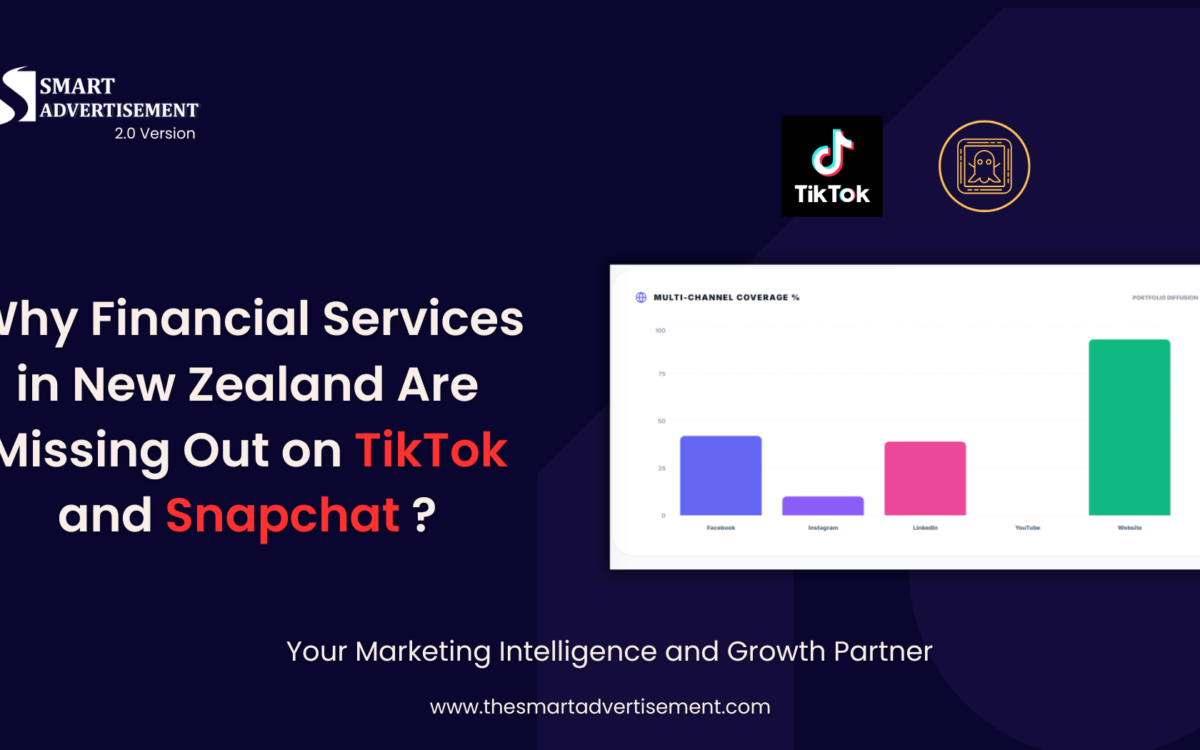
The financial services sector in New Zealand—covering mortgage brokers, lending institutions, financial advisors, and insurance providers—is highly competitive. Businesses in this industry are constantly seeking ways to generate leads, establish credibility, and engage with clients.
However, a recent observation by Smart Advertisement 2.0, our Marketing Intelligence Platform, revealed a striking pattern: while financial service providers actively use Facebook and LinkedIn, platforms like TikTok and Snapchat are largely ignored.
This observation raises critical questions: Are financial brands missing a growing opportunity among younger audiences? Or are these platforms simply misaligned with the traditional tone of the financial industry?
Social Media Usage in New Zealand Financial Services
Based on our monitoring of hundreds of financial services profiles in New Zealand, we observed the following trends:
| Platform | Usage Frequency | Key Purpose |
|---|---|---|
| High | Community engagement, lead generation, retargeting | |
| High | Professional networking, credibility, B2B leads | |
| Medium | Brand awareness, engagement with visually oriented content | |
| YouTube | Medium | Educational video content, tutorials, long-form explanation |
| TikTok | Very Low | Almost no adoption for financial services marketing |
| Snapchat | Very Low | Minimal presence, largely untapped |
Observation: Facebook and LinkedIn dominate because they provide direct business value. TikTok and Snapchat, which thrive on short-form, entertainment-driven content, remain largely unexplored by New Zealand financial brands.
Why Financial Services Prefer Facebook and LinkedIn
Several strategic factors explain this trend:
1. Professional Credibility and Trust
Financial services rely heavily on trust. A client choosing a mortgage broker, financial planner, or insurance advisor wants evidence of credibility.
LinkedIn provides a professional environment to showcase expertise, certifications, client success stories, and company achievements. It aligns naturally with the industry’s tone.
Facebook, while more casual, allows firms to present localized social proof, client testimonials, and community engagement without compromising professionalism.
TikTok and Snapchat, on the other hand, are entertainment-first platforms. The short, informal style of content may conflict with the conservative, trust-based image financial services aim to maintain.
2. Audience Demographics
Financial decisions such as purchasing a first home, taking out loans, or investing are typically made by adults aged 30–55 years.
- Facebook: Strong engagement among this age group.
- LinkedIn: Preferred by professionals and business owners.
TikTok and Snapchat currently attract a younger demographic (18–30), many of whom are not yet active in financial markets. This demographic mismatch may discourage financial brands from investing in these platforms.
3. Robust Lead Generation Capabilities
Facebook and LinkedIn offer sophisticated advertising and lead generation tools:
- Lead Forms – capture contact information directly within the platform
- Advanced Targeting – by demographics, interests, behavior, or location
- Retargeting – nurture audiences who interacted with previous campaigns
Such capabilities directly support measurable ROI, which is crucial for industries like finance where marketing budgets are carefully scrutinized.
The Untapped Potential of TikTok and Snapchat
Despite current trends, TikTok and Snapchat may offer early-mover advantages for financial brands willing to experiment.
Why these platforms could matter:
- Future Client Base – Younger audiences on TikTok and Snapchat today will be financial decision-makers in 5–10 years. Early engagement can build brand familiarity and loyalty.
- Content Opportunity – Short, educational videos explaining topics like:
- First home buying
- Mortgage basics
- Investment planning
- Credit score management
- Lower Competition – Since few financial firms are active, early adopters may enjoy higher organic reach and visibility at lower advertising costs.
Example: TikTok accounts globally that focus on “financial education for beginners” have hundreds of thousands of followers, demonstrating that audiences are receptive to educational content delivered in a fun, digestible way.
Early Mover Advantage: Why Experimentation Matters
Financial brands that adopt TikTok or Snapchat now could secure a strategic advantage:
- Brand Recall: Young audiences exposed to mortgage, savings, or investment tips may remember the brand years later.
- Content Differentiation: While competitors rely on static posts on Facebook and LinkedIn, creative short-form content can help brands stand out.
- Marketing Insights: Experimentation allows firms to track engagement, understand emerging trends, and adapt messaging to younger demographics before competitors do.
Recommendations from Smart Advertisement 2.0
- Pilot Short-Form Content: Start small with 1–2 educational or “myth-busting” videos per week on TikTok. Measure engagement and leads.
- Leverage Creative Storytelling: Financial concepts can be simplified using visuals, humor, and real-life scenarios to increase retention.
- Integrate with Existing Strategy: Use insights from Facebook and LinkedIn campaigns to identify topics with proven engagement. Repurpose content into short, snackable formats.
- Track Emerging Demographics: Monitor which age groups start engaging with financial content on TikTok and Snapchat to refine targeting strategies.
Conclusion
The financial services industry in New Zealand is heavily reliant on Facebook and LinkedIn due to professional credibility, audience demographics, and strong lead generation infrastructure.
However, TikTok and Snapchat represent a largely untapped opportunity. Early experimentation could allow financial brands to build future audiences, gain organic reach, and differentiate their content before competitors catch up.
At Smart Advertisement 2.0, our marketing intelligence platform continuously monitors digital behaviors across industries. We advise financial brands to stay data-driven: continue leveraging current platforms, but also explore new ones strategically to capture emerging opportunities.
The question is not whether TikTok or Snapchat will become relevant. It is how soon your brand will take the first step.
